

One more. Written by Brivael Le Pogam
In 1957, a Russian immigrant published a novel of more than a thousand pages built around one question: what happens if the people who make the world run simply stop?
Its title is Atlas Shrugged. In France it's called La Grève, The Strike. It wasn't even translated into French until 2011. That tells you something.
This morning, I think Elon Musk wrote the sequel.
A. Where the book comes from.
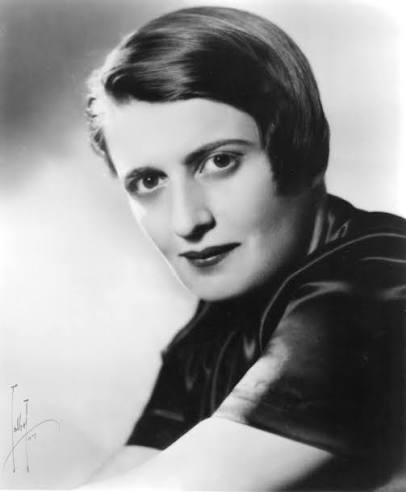
Ayn Rand was born Alisa Rosenbaum in Saint Petersburg in 1905. As a teenager, she watched Bolshevik soldiers walk into her father's pharmacy and seize it in the name of the people. Her family lost everything. Not to a competitor. To a committee.
She fled to America in 1926 and spent the rest of her life writing about one distinction: those who create, and those who seize.
B. The story.
In Atlas Shrugged, America is sliding into decline. Not because of war. Because of rules. Year after year, a growing class of bureaucrats, regulators and planners decides that production must be controlled, shared "fairly," frozen. They never build anything. They issue directives. The worst one freezes every worker in his job and forces every inventor to hand over his patents for the public good.
And one by one, the people who make the country run start disappearing. The best engineers. The industrialists. The inventors. An oil man sets his own wells on fire before vanishing. The whole country keeps repeating a question it doesn't understand: "Who is John Galt?"
John Galt is the man behind the disappearances. He has convinced the creators to go on strike. They withdraw to a hidden valley in the Colorado mountains, where everyone keeps what they make and trades freely. And they let the world find out what it looks like without them.
The lights go out in New York. The grey men are left alone with their directives, and discover that a directive has never produced a single kilowatt.
C. The core idea.
The strike isn't about money. It's about consent.
Rand's insight is that the system that captures the creators runs on their cooperation. It needs them to keep producing so it has something to redistribute. The bureaucrat is a parasite who needs a host. Remove the host, and he's exposed as what he always was: useless.
D. What Musk just did.
This morning, Musk announced that next year he will give one of his own SpaceX shares to every kid in America. "The first of many."
Here's what's fascinating. It's the strike, run in reverse.
Rand's creators withdrew. Musk stays. He keeps building rockets, satellites, AI. But instead of walking away from the system, he walks around it. The value goes straight from the builder to the citizen. No ministry, no agency, no committee in the middle.
Rand had to make the creators disappear to prove the bureaucrats were useless. Musk doesn't need to disappear. He just needs to stop routing value through them. Same result. The grey men are left standing in the middle of a pipe nobody uses anymore.
E. The difference that changes everything.
Rand's strike has a flaw her critics never stopped pointing out: ordinary people are left behind. The creators retreat to their valley. The rest of the country sits in the dark.
Musk's version fixes that. He isn't taking the creators out of the world. He's bringing the world into the valley. Every kid in America becomes a shareholder in the machine. Not a spectator of the strike. A participant.
That's the alliance being formed right now: builders and citizens, directly, with nothing in between. And the only people who lose that deal are the ones who never built anything.
F. Why now, and not in 1957.
In Rand's time, the strike was a fantasy. You couldn't produce at scale without the state's permission, and you couldn't reach every citizen without its pipes.
In 2026, one founder can build rockets, run a global network from orbit, and pledge equity to 73 million children in a single post. AI will soon do in seconds what a ministry does in years. The tools of the strike finally exist. And they don't require anyone to leave.
G. The ending.
For seventy years, "Who is John Galt?" was a shrug. A way of saying nothing can be done.
In the book, the strike ends when the creators decide the road is clear and walk back into the world to rebuild it.
That's the scene we're watching. Not a man leaving. A man coming back, with a gift for every child.
The grey men are about to discover what Rand promised them seventy years ago: a world that no longer needs them.

Send help......and a storage unit. He kept the m'fer a secret. Maybe I should come home with a pair of $1000 shoes.
Congratulation to @SGKusmertz, @bek1, and @wilbner. Your questions were chosen for tonight’s Ask Joe and the Panelists.
@SGKusmertz If you could have one song play when you enter a room, what would it be?
@bek1 Do you usually feel excited or stressed out about going back to school after summer break?
@wilbner What was the best prank you’ve ever pulled?
Interestin how the French aint includin the student muzzy groups in with CHOAS INC as agitators .
They know if they do France will burn to the ground.
When is the world gonna wake up.
These are not good people who want to fit in , they want you to join them or die , it's in their freakin koran.
I know people will say "It's not all muslums"
To that I say "Yes it is"....
Why don't all these good ones stand up to the bad ones and say....
"This is not us , you must stop."
Because it is them.