


𝑭𝒓𝒐𝒎 𝑵𝒊𝒄𝒆 𝒊𝒏 𝒕𝒉𝒆 𝒔𝒐𝒖𝒕𝒉 𝒕𝒐 𝑳𝒊𝒍𝒍𝒆 𝒊𝒏 𝒕𝒉𝒆 𝒏𝒐𝒓𝒕𝒉-𝒆𝒂𝒔𝒕, 𝒇𝒓𝒐𝒎 𝑩𝒐𝒓𝒅𝒆𝒂𝒖𝒙 𝒊𝒏 𝒕𝒉𝒆 𝒘𝒆𝒔𝒕 𝒕𝒐 𝑮𝒓𝒆𝒏𝒐𝒃𝒍𝒆 𝒊𝒏 𝒕𝒉𝒆 𝒔𝒐𝒖𝒕𝒉-𝒆𝒂𝒔𝒕, 𝑭𝒓𝒂𝒏𝒄𝒆 𝒘𝒂𝒔 𝒈𝒓𝒊𝒑𝒑𝒆𝒅 𝒃𝒚 𝒂𝒏 𝒐𝒓𝒈𝒚 𝒐𝒇 𝒗𝒊𝒐𝒍𝒆𝒏𝒄𝒆, 𝒂𝒓𝒔𝒐𝒏, 𝒓𝒂𝒎𝒑𝒂𝒈𝒆, 𝒕𝒉𝒆𝒇𝒕 𝒂𝒏𝒅 𝒅𝒆𝒔𝒕𝒓𝒖𝒄𝒕𝒊𝒐𝒏.
Good moaning, friends across the water. I greet you well.
A quickie, while I have a few minutes to go online.
The article below is paywalled, from today's Daily Mail.
Another day in the multi-cultural idyll that is Europe.
===================================
𝐓𝐡𝐞 𝐨𝐫𝐠𝐲 𝐨𝐟 𝐯𝐢𝐨𝐥𝐞𝐧𝐜𝐞 𝐢𝐧 𝐅𝐫𝐚𝐧𝐜𝐞 𝐦𝐚𝐤𝐞𝐬 𝐚 𝐑𝐢𝐠𝐡𝐭-𝐰𝐢𝐧𝐠 𝐋𝐞 𝐏𝐞𝐧 𝐯𝐢𝐜𝐭𝐨𝐫𝐲 𝐚𝐥𝐥 𝐛𝐮𝐭 𝐢𝐧𝐞𝐯𝐢𝐭𝐚𝐛𝐥𝐞 𝐧𝐞𝐱𝐭 𝐲𝐞𝐚𝐫
by Andrew Neil
Every generation or so the course of French democracy is determined on the streets. Be in no doubt that just happened again at the weekend. Or that, though it was provoked by the hard-Left, it is the hard-Right that will benefit.
Those looking in from afar might not have grasped the scale or ferocity of what happened. The riots – in places bordering on urban warfare – which erupted across the country from late Saturday afternoon onwards were the worst for a very long time.
Protests by high-school students complaining about class sizes, a teacher shortage and crumbling schools have been going on for a month, sometimes involving sporadic violence. In recent days they've been joined by a resurgence of the 'yellow vests' – ordinary provincial French folk struggling with rising prices to make ends meet, who first came to prominence in 2018 protesting about the high price of diesel, which is soaring again along with other costs.
Plans were made for the 'jeunes et jaunes' – the young and yellow – to come together on Saturday for marches in every major town and city. The day proceeded peacefully enough. Young and yellow did indeed march together, joined by teachers, parents, trade unionists — numbering countrywide between 500,000 (police estimate) and 800,000 (organisers estimate).
There was little trouble. Until the official protests came to an end and the organisers drifted away. It was then that far more sinister, violent forces took over. That often happens at the end of French demonstrations. But this time the disorder was off the charts.
Yesterday morning I scanned the front pages of France's main regional Sunday papers (there isn't really a French national press). Every single one had pictures of buildings going up in flames and thugs on the rampage, with the word 'chaos' in banner headlines some added another word – 'insurrection'.
If anything, that was an understatement. The centre of almost every major city and town was a battleground.
The heart of Paris, from the Champs-Elysees to the Bastille, was like a war zone. Everywhere was trashed. Widespread looting was the worst anybody could remember. Masked youths, nearly all clad in black, many draped in keffiyehs, emerged from shops with bags stuffed with clothes, sneakers and smart phones. The police simply couldn't cope.
'There was a level of violence I believe we have never seen before,' said the capital's shaken deputy mayor. It was worse in Marseille, France's second city, where the police were forced to retreat and effectively lost control of the city centre for several hours.
The main drag in Lyon, France's elegant third city and gastronomic capital, was devastated by looters – windows smashed, shelves emptied, debris everywhere. The tourist office was set on fire and left to burn down – because masked thugs wouldn't let firefighters near it. All the city's useless Green mayor could muster were platitudes about it all being 'unacceptable'.
No major urban centre escaped the unrest. From Nice in the south to Lille in the north-east, from Bordeaux in the west to Grenoble in the south-east, France was gripped by an orgy of violence, arson, rampage, theft and destruction. Even the city halls of Marseille and Lille were invaded and badly vandalised.
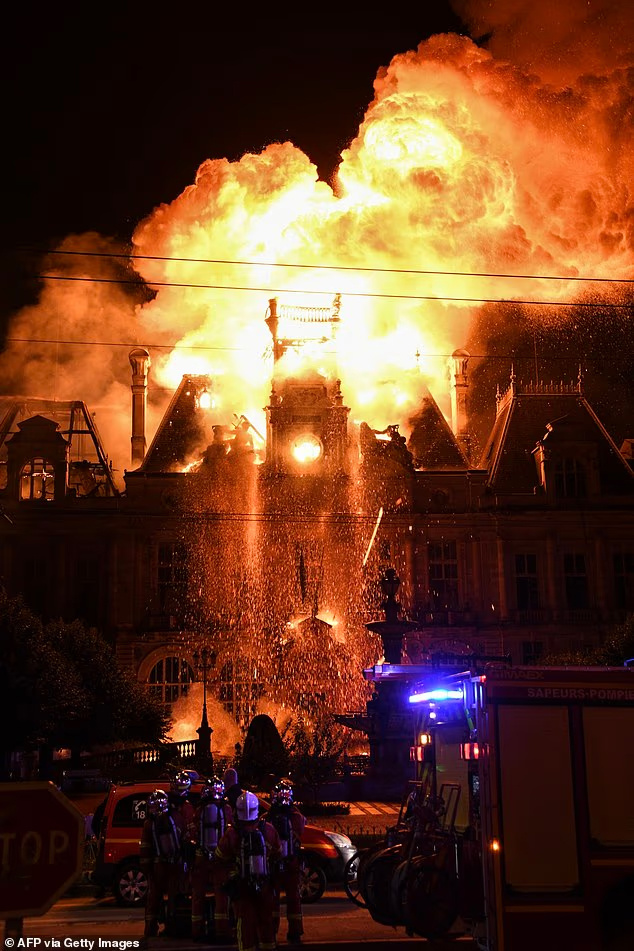
This matters in France, where elected mayors have real power and the city or town hall – the hotel de ville – is regarded as a local symbol of republican democracy in action. Which makes the destruction of the town hall in Limoges perhaps the weekend's worst, most totemic atrocity of all.
An imposing neo-Renaissance building completed in 1883 – the glory of a charming town sitting between Paris and Bordeaux – it boasted a beautiful facade topped by a belfry, the inside dominated by a gloriously grand ceremonial staircase. It is now, as I write, a smoking ruin.
The anger of the country is palpable – and it has quickly dawned on most folk that none of this anarchy was spontaneous.
It was organised by hard-Left activists intent on exploiting legitimate protest to sow mayhem, fanned by the henchmen of Jean-Luc Melenchon, who combines the Leftist fantasies of Jeremy Corbyn (former British Labour Party leader) with the rabble-rousing of a veteran charlatan – which makes him much more dangerous.
These far-Left extremists were joined by young criminal gangs from the 'banlieues', the miserable suburbs which now ring most French towns and cities, where migrant families have settled, often in some squalor and with little hope of escape.
Since both groups are young, usually dress in black and hide behind masks or balaclavas, it is not easy to differentiate between them, and there is, of course, some overlap between the two. But together they make a formidable force for urban unrest.
Sebastien Lecornu, France's weak, centrist prime minister, was quite explicit about this. He blamed 'far-Left groups' for 'organised acts of violence' and 'criminals' who 'joined in to loot and destroy'. But there are also deeper, systemic forces at work.
The French expect the state to be omnipresent in their lives. Yet the country no longer generates the wealth required to finance what the French want the state to do for them. Which is a lot – generous cradle-to-the-grave welfare plus plenty of state largesse in between. The French economy is stagnant. But the French refuse to downgrade their demands on the state.
Ironically, the reason for the stagnation is that the state is far too big. In many ways, France is Andy Burnham's idea of paradise. Government spending accounts for an incredible 57 per cent of France's GDP, the highest in Europe after Finland.
The state owns nearly all public services, public transport, energy and utilities. What it doesn't own it controls through extensive state regulation and subsidies. Private companies are expected to work hand-in-glove with the state.
Out of an adult population of 55million, over 30million depend on the state for most of their income — pensions, state jobs, welfare payments. Economic stagnation has done nothing to make them realise they need to settle for less.
State pensions take up 14 per cent of GDP, six points more than the European average. Pensioners often enjoy higher incomes than workers who are being taxed to pay for their pensions. Yet all efforts at reform, including raising the retirement age (the lowest in Europe) are met with outrage – and, inevitably, street protest.
France's debt and deficit make Britain look almost prudent. The national debt is close to 120 per cent of GDP (versus our 100 per cent). The annual budget deficit is 5 per cent and rising (we are closer to 4 per cent and falling). Yet the demand is always for more spending. Suggested cuts are rebuffed. The government can't even get its 2027 budget through parliament.
France is in desperate need of reform – but as all recent presidents have found out to their cost, from Chirac in the 1990s to Macron today, the country is unreformable. Add in mass migration – a relatively recent influx of up to 5million often Muslim migrants from Africa and Asia – and the problem is compounded.
The French economy does not generate jobs for them (at least one in five young migrants are unemployed). Thus to the doom loop of economic decline has France added a toxic social tinderbox.
That is the backdrop to this weekend. The appalling scenes of carnage and anarchy which have since dominated French TV screens make the victory of the Right-wing Marine Le Pen in next spring's presidential elections all but inevitable. No matter who she's up against, every poll shows her winning. If it ends up between her and Melenchon, she wins by a two-to-one landslide.
That won't be the end of France's problems. Far from it. She is no reformer. Much of what she proposes would make matters worse. Her very presence in the Elysee Palace could split France asunder. Saturday, I fear, might just be a harbinger of even worse to come. 'L'agonie de la France' has, as yet, no end in sight.

Send help......and a storage unit. He kept the m'fer a secret. Maybe I should come home with a pair of $1000 shoes.
Congratulation to @SGKusmertz, @bek1, and @wilbner. Your questions were chosen for tonight’s Ask Joe and the Panelists.
@SGKusmertz If you could have one song play when you enter a room, what would it be?
@bek1 Do you usually feel excited or stressed out about going back to school after summer break?
@wilbner What was the best prank you’ve ever pulled?







@goodwitch Although I'm not on every day, I sure miss your Gratitude Circle. JM
Today I am grateful that our "friend we have not yet met", @johnconner2046, is back here in the Gutter. I am grateful for a day off today, and a productive weekend of getting some chores done. Wishing everyone a wonderful Monday!