




GRATITUDE CIRCLE 🌎
I am grateful for another day in America.
I am grateful to have the semester behind me, and to be planning the next season of classes.
I am grateful for a surprise visit from another of my cousins who is like a niece to me, and the time we had while she was here to break bread together and get caught up. What a lovely gift.
Namaste as you journey through your day - 🎄- Happy Birthday to the National Guard
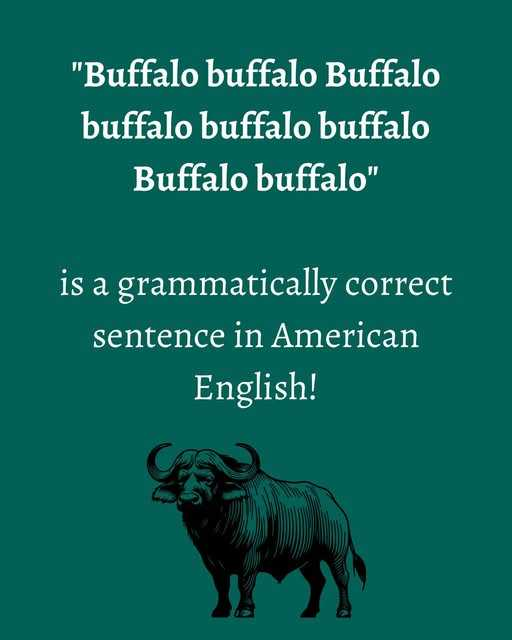
A little Saturday morning grammar lesson from The Language Nerds:
Yes, this is a fully grammatical sentence in American English, even though it looks like linguistic nonsense at first glance.
The key lies in the word “buffalo,” which performs multiple grammatical functions in the same sentence:
– Buffalo (proper noun): the city of Buffalo, New York
– buffalo (common noun): the animal (bison)
– buffalo (verb): to intimidate, bully, or confuse
When these meanings are combined through relative clause ellipsis, the sentence becomes structurally sound. In expanded form, it means:
“Buffalo bison, which other Buffalo bison bully, themselves bully Buffalo bison.”
Nothing here violates the rules of English syntax. What is violated is our intuition about how repetitive a sentence is allowed to be before it feels absurd.
This example is often used to illustrate how syntax, semantics, and lexical ambiguity interact in natural language—and how grammaticality does not always guarantee clarity....