


Some Communications History for your consideration:
In 1901, the most brilliant scientific minds in the world agreed on one absolute truth.
Radio waves could not bend around the curve of the Earth.
To the established physicists of the day, wireless communication was strictly limited to the line of sight. They believed that trying to send a signal across the Atlantic Ocean was more than just ambitious.
They said it was scientifically impossible.
But a 27-year-old Italian inventor named Guglielmo Marconi decided to bet his reputation against the experts.
The status quo of the era was defined by heavy, expensive undersea telegraph cables.
Since 1866, the only way to transmit a message from Europe to America was through insulated copper wires laid deep on the ocean floor.
These cables were incredibly costly to manufacture, difficult to lay, and extremely vulnerable to sabotage or damage.
Global communication belonged to the rich giants of the telegraph industry, and they had no interest in change.
But Marconi had a vision that defied the textbooks.
He believed that radio waves would somehow follow the curvature of the Earth, despite the naysayers insisting the waves would shoot straight off into space.
He set up a massive spark-gap transmitter in Poldhu, Cornwall, England, to blast a signal westward.
Then, he traveled over 2,000 miles across the freezing North Atlantic to St. John’s, Newfoundland.
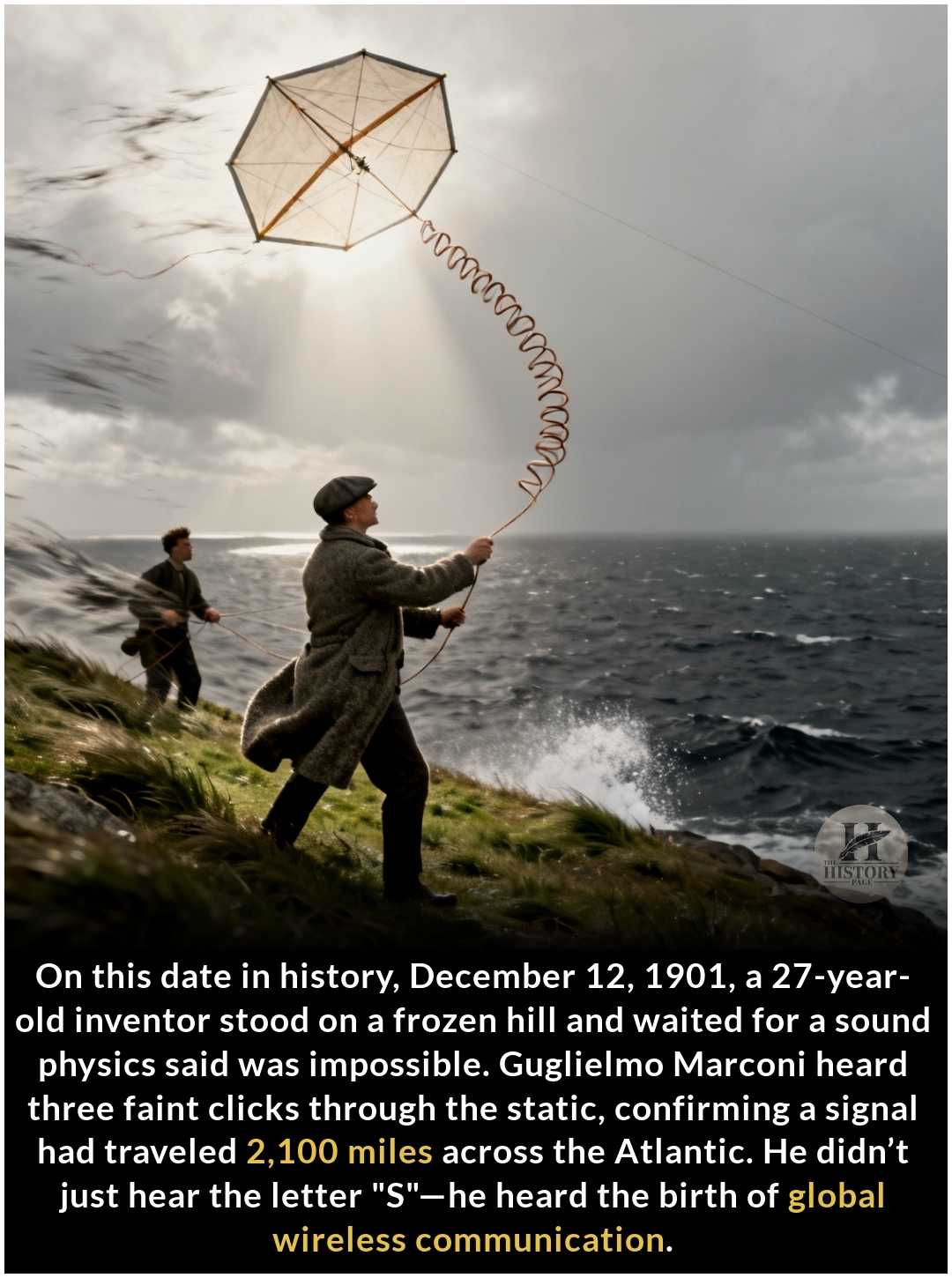
On December 12, 1901, the conditions on Signal Hill were miserable.
Marconi stood on the exposed cliffside, battling biting winds and freezing temperatures.
His first attempt to raise an antenna with a balloon failed disastrously when the gale ripped it away.
Undeterred, he and his assistant, George Kemp, managed to launch a large kite carrying a simple wire antenna 500 feet into the gray, turbulent sky.
Inside an abandoned building, wired to a sensitive coherer receiver, Marconi sat and waited.
He wasn't waiting for a speech.
He wasn't waiting for a symphony.
He was waiting for three short, distinct clicks.
The plan was for the team in England to transmit the Morse code letter "S" repeatedly.
At 12:30 PM, through the crackle of atmospheric static, it came.
Dot. Dot. Dot.
He handed the headset to Kemp to verify the faint sound.
He heard the signal.
He heard the impossible.
He heard the future.
That faint sound had traveled more than 2,100 miles, defying the curvature of the Earth and the consensus of the scientific elite.
We later learned about the ionosphere—an atmospheric layer that bounces radio waves back to Earth—but Marconi didn’t need to understand the mechanism to believe in the result.
This moment broke the monopoly of the physical cables.
It paved the way for radio broadcasting, ship-to-shore safety, and eventually the cell phone in your pocket right now.
It proved that just because the experts say it cannot be done, doesn't mean there isn't a way.
The world got smaller that day, not by wires, but by faith in the unseen.
Sources: History .com / Britannica / NobelPrize .org
#history #facts #innovation #education
... dit-dit-dit


GRATITUDE CIRCLE 🌎
I am grateful for another day in America.
I am grateful for the end of the semester except for a few loose ends that can be cleared up next week.
I am grateful for the flexibility and cooperation of my staff and clients.
Namaste as you journey through your day - 🎄- it's National Ambrosia Day